CORNE CHOC PRO / NEOPRENE TRAVEL CASE

Closes like
a book.

One piece of neoprene sewn into a tube, with one seam across the middle that splits it into two pockets. That seam is also the hinge: fold the case shut, keycaps facing in, and one loop of black 30 mm elastic holds it closed. A small pocket on the back holds the cables. Two main seams, all by hand. Just the keyboard: no puck, no attachment.

Two main seams · knob height assumed
Drag to rotate · scroll to zoom

Loading the actual STL files…

Folded shut at the middle seam, which rolls round the spine. The cable pocket sits on top under the strap, and the strap also holds both openings shut on the far side. Closed it is 144 × 125 × 72 mm.

Open viewer ↗
ONE HALF136.4 × 95.6 mm

23 mm tall at the encoder knob

NEOPRENE349 × 300 mm

One piece, plus a cable pocket

STRAP, 30 MM ELASTIC313 mm

One loop, holds it shut

CLOSED144 × 125 × 72 mm

Open flat · 144 × 256 × 38 mm

01 / YOUR KEYBOARD

What the case is sized from.

Half outline136.4 × 95.6 mmUpstream Corne v4 3x6 case; Keebart publishes no outline
Case and plate8.2 mmKeebart's product image
Keycap tops18 mm above the desk16 mm above the case underside on 2 mm feet, both earlier assumptions on this site
Rubber feetØ8 × 2 mmAssumed
Encoder knobØ14 mm, top 23 mm above the deskAssumed 5 mm above the keycaps. If yours stick out about 10 mm, cut the neoprene 359 × 318 mm instead.
Keys22 keys and an encoder per half19.05 mm pitch, from the Corne v4.1 choc PCB

02 / CUT LIST

What to cut.

Neoprene, 3 mm, fabric both sides1 piece, 349 × 300 mmThe whole case
Long seam10 mm inJoins the two 300 mm sides into a tube
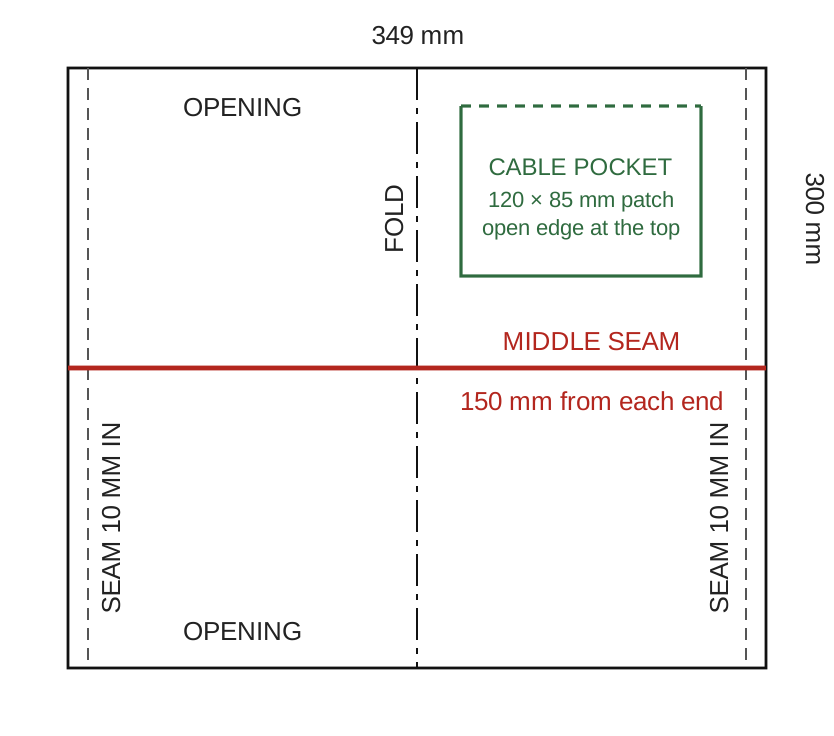
Middle seam150 mm from either endSplits the tube into two pockets and is the hinge
Cable pocket120 × 85 mm patchFrom the leftover neoprene, sewn on along three sides 5 mm in, before the tube is closed
Strap, 30 mm black elastic1 loop, 313 mmIncludes 20 mm of overlap to sew it shut. A few stitches hold it to the spine.
Divider136 × 96 mmThin stiff plastic or card between the halves, so the keycaps and knobs never press into each other

03 / HOW TO MAKE IT

Two main seams, by hand.

Cutting diagram: one 349 by 300 mm rectangle. A 120 by 85 mm cable pocket patch sits 22 mm from the fold line and 19 mm from one end. Fold it so the two 300 mm sides meet and sew them 10 mm in to make a tube, then sew straight across the middle, 150 mm from each end.

You need

  • 3 mm neoprene fabric with fabric on both sides, at least 349 × 300 mm
  • Strong thread and thick, sharp hand-sewing needles; a cheap leather sewing kit has both, plus a thimble and an awl for poking the holes first
  • 8–12 sewing clips or clothes pegs
  • 30 mm black elastic, about 35 cm
  • Ruler or tape measure, tailor's chalk and fabric scissors
  • A 136 × 96 mm piece of thin stiff plastic or card for the divider

The one stitch you need

Every seam is a backstitch. Knot the thread, bring the needle up through the fabric, then push it back down about 5 mm behind where it came out. Bring it up again 5 mm in front of the thread and repeat. Each stitch meets the last one, so the line is solid. Knot it again at the end.

Steps

  1. Mark a 349 × 300 mm rectangle on the neoprene with chalk and cut it out. From the leftover, cut a 120 × 85 mm patch for the cable pocket.
  2. Lay the patch on the outside face of the big piece, 22 mm from the fold line and 19 mm from one short end, as in the diagram. Backstitch it on along both sides and the edge nearest the middle, 5 mm in. Leave the edge nearest the end open.
  3. Fold the big piece in half so the two 300 mm sides meet, outside faces together, so the patch ends up inside. Clip them every 5 cm.
  4. Backstitch those two sides together, 10 mm in from the edge. You now have a tube, open at both ends.
  5. Turn the tube right side out, like a sock, and flatten it with the seam along one side.
  6. Slide a half in from each end, keycaps up and the cable pocket underneath, to check the fit. Then take them out again.
  7. Measure 150 mm from one end and chalk a line straight across. Backstitch along it through both layers. That one seam makes the two pockets and is the hinge.
  8. For the strap, cut 313 mm of elastic, overlap the ends by 20 mm and sew a small square through both layers to make a loop.
  9. To pack, unplug the cables, coil them and push them into the cable pocket. Slide a half into each pocket, keycaps up and the cable pocket underneath. Lay the divider on one half, fold the case at the middle seam so the keycaps face each other, and slip the strap over it. The strap also holds both openings and the cable pocket shut.
  10. The first time it's packed, put 4–5 stitches through the strap and the middle seam where they cross, so the strap stays on the case. To open it, roll the strap off the top half; it stays attached at the spine.

Don't pack it damp. It protects against bumps and rubbing in a bag, not crushing.

Files, sources and checks +

CAD and mesh check results are in the dimension report.

The keyboard model uses the switch positions from foostan's Corne v4.1 choc PCB and the outline of the upstream 3x6 case (CC BY 4.0). Keebart's own case may differ slightly; the neoprene stretches enough to cover that.